Small Disclaimer: As ever, this post requires some listening, so all the underlined words are links to the relevant Youtube videos and require a simple click to understand what I’m going on about. Enjoy!
When in the company of musicians I admire, I often find them talking about the ability to tell a story through one’s solo. By ‘story’, I mean the emotional journey that the composer intended to take the listener through with their music. Jazz solos, for example, can often sound, depending on the style, and to the untrained ear, erratic and directionless. I’m sure Charlie Parker’s famous ‘break’ in A Night In Tunisia sounds so impossibly fast to some that the task of learning it, or even extracting any emotion from it, seems unlikely. But there is a reason why Charlie Parker played each of those notes, one that only he knows, and that others can only theorise about since music is intrinsically personal and each may have their own reasons. Engaging actively with music is how you really begin to understand it, as you would engage with a good book. You give it your full attention, and in return, you will feel the full force of its emotive purpose. It is how you begin to internalise different composers’ styles and get to know each of them on a more personal level. I would like to share that experience with you, the reader, through two works in particular; J. S. Bach’s ‘Violin Concerto in A minor’ (BWV 1041) and Kurt Elling’s ‘We Three Kings’.
If you happened to sit the 2018 AQA A-Level Music exam last month, you will understand why I chose this concerto. Having analysed this work over the last two years with the help of teachers and exam specifications, I know that there is plenty to talk about. Now, I apologise for the following descriptions of the concerto’s technical intricacies, but all this technical ‘nitty-gritty’ that often scares people away from studying music theory is really just a means of painting a picture, stroke by stroke, of the story that Bach is trying to tell through this concerto. So do stay tuned in, for the more the listener understands of the composer’s musical choices, the more layers they can traverse, and the richer their listening experience will be.
Starting briefly with the first movement in A minor, it has a ‘ritornello’ structure. This means this passage from 0:00 to 0:35 is the main theme, and a truncated form of this theme is repeated throughout, each theme separated by solo episodes. Think of a club sandwich; the bread is the theme, and the filling the solo. Taking a look at the theme in this first 30 seconds and we already get a taste of the movement’s ‘story’ – note that at 0:21, and 0:26, we expect the theme to end, but Bach keeps us on the edges of our seats by delaying that resolution. At the end of the 30 seconds, we hear another moment where we expect it to resolve, but he ends on a major chord rather than the expected minor (a typically Baroque harmonic technique called a ‘tierce de Picardie’). This semiquaver melody line at the beginning (0:11) is particularly arousing:

This first thirty seconds is dynamic, dramatic, and thrilling and with the constant lack of resolution, is Bach’s way of saying “This is what you’ve bought your tickets for, so listen up!”
The third movement, also in ritornello form, is an electrifying finale to the concerto. If the soloist hasn’t already been put to work in the first two movements, they certainly earn their bread in the third. Have a listen first, and concentrate on what the soloist is playing so as to not lose focus: https://youtu.be/HTr8KHDmMWw?t=9m55s
At that speed, it’s almost like watching an adrenaline-packed movie scene, like the high speed car chases of the Jason Bourne films, or the intense Western-style shootouts of any great Tarantino movie, where you can’t help but feel the adrenaline.
This movement is in 9/8 time, meaning the beat is divided into three. Time signatures that are in ‘compound time‘ (where the beat divides into three) naturally push the music forward and make the listener want to move (hence waltzes, i. e. dance music, being in 3/4 time). It’s as if the music is always trying to catch up with something (or escape something), and only ever reaches it (or gets caught) when it ends. The theme coming back in C major at 11:17 gives the listener a brief moment of positive energy – an homage to the major tonality of the previous movement. Perhaps it is Bach’s way of reassuring us that in whatever dark landscape he paints with his minor tonalities, there is hope, that there is good to be found even when surrounded by evil. That feeling of hope, of imminent resolution, is amplified at 11:55 , when there is a brief pause in the almost constant quavers, on a dominant 7th chord whilst the soloist goes wild with decorative melodies, effectively suspending the music in mid-air – but this pause is only a brief interlude, before the bass pulls us back down with its plunge into the main theme in a minor tonality, like a hawk diving for its prey.
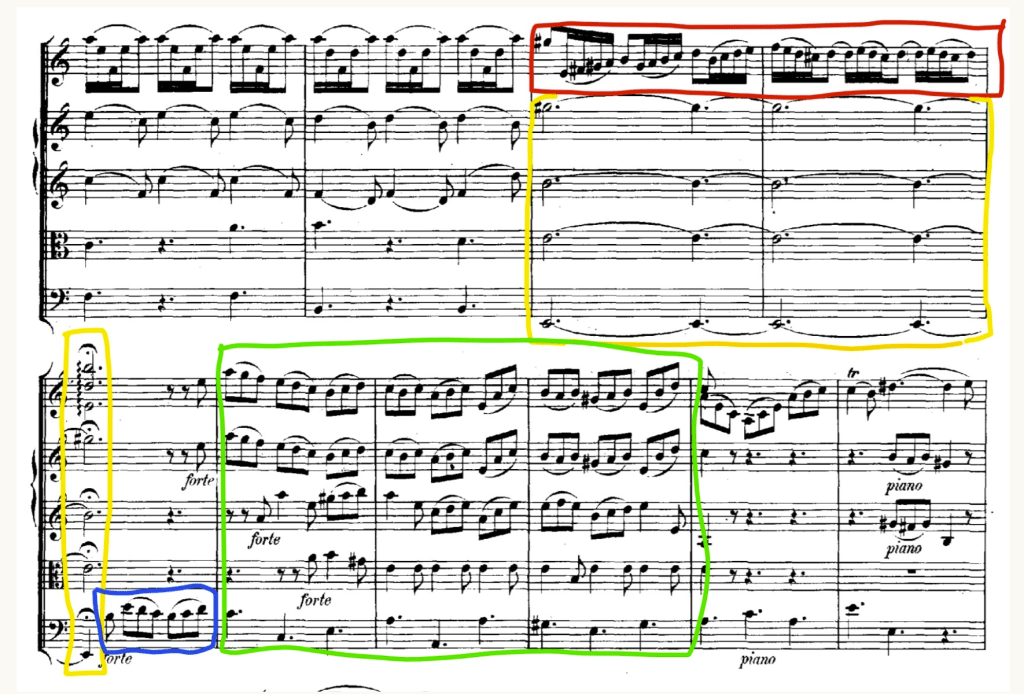
Red: Soloist. Yellow: Dominant 7th chord held by orchestra.
Blue: Bass bringing back the quavers. Green: Main theme for 3 bars.
I can’t listen to this piece enough, because each time I do, I sense a new meaning in it’s spiralling melodies and labyrinthine textures. Two years ago I would never have been keen to listen to a Bach concerto as intensely as I have done with this one, and studying this piece has opened up my ears to an entirely new sonic experience, that is to truly appreciate the emotive purpose of a piece of music through the composer’s personal musical choices. So, I suppose A-Levels are good for some things, at least.
Kurt Elling, being an active musician some 350 years after Bach, has the privilege of the immense spectrum of newly developed sounds of the twenty first century at his fingertips to craft his musical narrative. I remember sitting beside my mum as we drove along the motorway, playing my music through the car speakers, and Kurt Elling’s ‘We Three Kings’, from his Christmas album ‘The Beautiful Day’ began playing. I was listening to this piece properly for the first time – concentrating on the sounds and their meanings, rather than passively tuning in and out of the music. I thought about the title, ‘We Three Kings’, and wondered how the singer would approach this traditional Christmas tune and make it into something distinctively ‘Elling’. Suffice to say, I was not disappointed.

This opening piano ostinato sounds more like falling snow than falling snow. Already, through a combination of this and the title, we have an image in our minds. The 6/8 metre is once again a compound time signature, and as we know from Bach, it suggests movement. In 6/8, beats 1 and 4 are the most ‘important’, and here you can see that beat 4 is left completely empty. This, and the addition of heavier percussion from 0:24 makes me think of lumbering camels trudging their way through mountainous lands with three travellers on their backs, following a distant star. Elling then offers us a brief moment of familiarity – he enters with the original tune to ‘We Three Kings’ at 1:00 – but he doesn’t let us get too comfortable. He plays with the rhythm, displacing the accent on “are” and “far”, and the overlapping of voices suggests that there are multiple people – the three kings – singing the melody.
A brief guitar solo interlude explores other harmonic landscapes, as the kings would on their travels. The next verse, straying away from the familiar lyrics, has an odd sense of metre, and I’m not even quite sure what the time signature is here, so please do share your thoughts on that if you have any. But the rhythmic irregularity of this section is simply to create tension, as the explosive return to the recognisable 6/8 time signature and chorus at 2:20 feels like a return home, or to our royal protagonists, it is the relief felt when finally witnessing the “royal beauty” of the star. An image that came into my mind when hearing the sudden ‘drop’ back to the introductory textures at 2:47 with the word “light” was that the whole of those first three minutes were simply the kings reciting the prophecy, not yet fulfilling it, or perhaps an angel who recounts the story to them ahead of their journey. After a lengthier guitar solo and additional vocal sections, the same ‘drop’ happens at 4:50, only this time the arrival of the word “light” is delayed slightly. To me, this says again that the kings haven’t begun their journey yet, or the delay could suggest some doubt in the kings’ mind about the prophecy. Alternatively, it could suggest their overwhelming reverence for the star and for their religion. Ultimately, it is up to the individual to decide. I’m sure Elling has his own reasons, and I’m sure he’d want you to have yours.
We all have our own ways of enjoying music. The last thing I want is to give the impression that I believe that there is a ‘right’ way and a ‘wrong’ way. Music, as well as being something truly personal, is paradoxically also entirely public. Once sound is expelled from its source, nothing can stop it from reaching someone else’s ears, and the way it is heard therefore cannot be policed. It is an art form of community and solidarity, and yet of the individual. Because of this, there is a world of emotion and depth to be found in music that is so rich and vivid, and is accessible to anyone who takes the time to listen. Music can be simple background noise, but it can also be the most profound and authentic portrait of the human. And as we know from books, films, theatre, gossip, campfires, and blogs, humans love to tell stories; and so it is unsurprising that music and telling stories are inseparable.
 Isla's Blog
Leave a comment