My brother introduced me to the Japanese math rock band ‘tricot’ recently. Until now I had never heard of ‘math rock’ before, and I have to say that it has been an incredibly pleasing discovery. Time signatures are some of my favourite things to play around with. One of the first Jazz tunes that I learnt on the piano was Dave Brubeck’s ‘Blue Rondo a la Turk‘, which is from his 1959 album ‘Time Out’. The story goes that Brubeck heard Turkish street musicians performing the rhythm, and was inspired to write his Rondo. And supposedly, when asked where the rhythm came from, the musicians explained that this rhythm is to them what the blues is to us. I can’t help wondering what it must be like to be a part of a culture whose music is more often NOT in 4/4, and I can’t help feeling slightly envious.
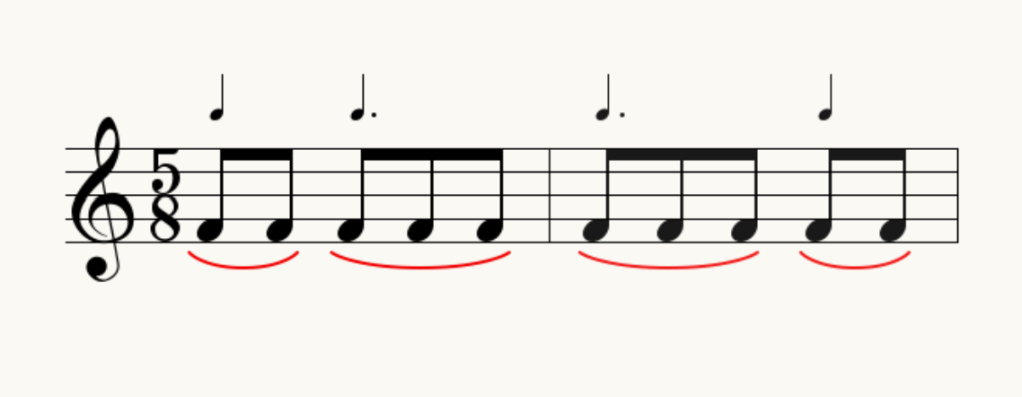
However, this does not stop us from exploring the world of rhythm and metre, which is very exciting. The kind of rhythm in Brubeck’s piece is referred to as ‘aksak’ rhythm, meaning ‘limping’ in Turkish. In simpler, more English terms, it is what one would call ‘additive rhythm‘. For example, 5/8 can be formed by the addition of 2 + 3 quaver beats. Here we are adding two units of rhythm to form one overall ‘irregular’ metre. With the image on the left, you can clearly see the groupings of two beats plus three beats, or vice versa (and the same goes for other irregular metres, such as 7/8 = 2 + 2 + 3, or 10/8 = 3 + 3 + 2 + 2). Brubeck’s piece is in 9/8, though alternating between divisions of 2 + 2 + 2 + 3, and 3 + 3 + 3. If that hurts your brain, as it did mine to start, here is an incredibly helpful virtual visualisation of the pattern, courtesy of Wikipedia – and don’t forget to listen to Dave himself to understand the context.
You can see now why ‘math’ was mentioned in the opening paragraph. The reason for this post, however, is not to lecture you on rhythm, or math. The reason is because I am really interested by the aforementioned tricot’s ‘Ochansensu-Su‘, and I’m hoping to get together a team and recreate that wonderful tune as a jazz piece. Please do have a listen to the original, whether math rock is your thing or not. Songs like that are, to me, like reading a really good book. There’s so much to take in and appreciate, in terms of technical complexity and musicianship. You (or at least I) could easily spend all day analysing it, reading between the lines, relating each note to a different meaning each time it is heard. After all, that is why music exists, to have meaning.
Anyway, I will stop there before I get too philosophical. I figure that this is exactly what blogs are for, to keep a record of goings-on, so consider this the first update of this small project. If all goes well, I will try to get a good recording and video of the final piece and post it here, so keep an ear out!
If you are a music nerd too, or if you just like the sound of irregular metres, here are some more favourites of mine that go a bit crazy with the time.
Fuguefat – The Octopus Project – Really interesting 7/8 piano riff, and complemented by some intense drumming.
Pyramid Song – Radiohead – Possibly one of Radiohead’s greatest songs, in my opinion of course. The hesitation just feels really quite uncomfortable, and there is much debate around what the time signature actually is.
Raggy Waltz – Dave Brubeck – Some more Brubeck, because it’s a pleasure.
The Dance – Kurt Elling – Beautiful use of guitar and voice.
Alternatively, check out Adam Neely on youtube – Here he talks about odd time signatures, and how to play them. Really worth looking at!
 Isla's Blog
Leave a comment